
Rooks Projected Release Meaning
KDOC uses the field name Anticipated release date. Its public-records material also uses the more exact phrase anticipated guidelines release date. Both describe a forecast for a KDOC sentence under the computation that exists when the record is viewed. Neither field proves that a person left prison on that day.
The Rooks County Jail has a different record system. Its live roster displays a compact “Date” associated with a current booking, plus the person’s name, booking number, charges, bond, arresting agency, age, sex, race, and image. The sheriff does not label that field as a release date. The roster has no projected-release calculation, released tab, archive, or release timestamp. A bond amount also does not prove payment or departure.
| Question | Source | What the date means |
|---|---|---|
| When might a KDOC prison term end? | KASPER or KDOC sentence record | Current anticipated guidelines release date |
| When did Rooks jail custody end? | Sheriff booking/release record | Actual administrative release or transfer time |
| What ordered county release? | Rooks court file | Bond, dismissal, sentence, credit, or other authority |
| Has all KDOC supervision ended? | KDOC certificate of discharge | Formal final discharge, not merely prison departure |
Lookup Rooks KDOC Release Dates
KASPER means Kansas Adult Supervised Population Electronic Repository. It covers people and cases associated with KDOC-operated or funded programs. The disclaimer says the data updates each working day. It is not a Rooks County bond-release list and is not a complete criminal-history system. A missing result does not disprove a county-jail release, probation event, or case outside KDOC.
- Open the KASPER search gateway and read the disclaimer.
- Search by KDOC number when available. Otherwise use the name and identifying details provided by the portal.
- Separate same-name results with date of birth, physical descriptors, photograph, conviction county, and case number.
- Open the matching record. Read current location, movement dates, supervision status, sentence data, and anticipated release date together.
- Save the query time and KDOC number. Recheck after the date, then request a KDOC record if exact proof is needed.
The KDOC locating-an-offender information identifies fields that may be available, including name, KDOC number, date of birth, descriptors, photograph, conviction crime and county, case number, anticipated release date, current location, movement dates, custody or supervision level, and parole office. The official field-list capture provides a visual reference.

The image shows the official source behind the lookup fields. A current person record must still be opened and verified because the page itself does not report an individual release.
Rooks Release Date Calculation
A sentence computation starts with the controlling sentence and its beginning date, then accounts for applicable jail or prison credit, consecutive terms, offense-specific law, and earned or lost credit. A controlling sentence is the term that governs the current calculation when more than one sentence is involved. Consecutive sentences run one after another rather than at the same time.
Good time can reduce the prison portion within statutory limits when it is earned and retained. Program credit may apply after successful completion of designated education, vocational, treatment, or risk-reduction work. Credit can be withheld or forfeited. Disciplinary events, corrected court entries, another controlling sentence, a detainer, or revocation can move the forecast. A detainer is a request or legal hold from another authority that can affect what happens at the end of the current term.
- Anticipated date
- A forecast based on the current KDOC calculation.
- Good time
- Credit governed by statute and KDOC rules that may reduce the prison portion.
- Program credit
- A separate possible credit for eligible completion of designated programs.
- Detainer
- A hold or request from another authority that may prevent community release.
Rooks Release Is Not Always 85%
Kansas does not have one universal 85% rule. Under K.S.A. 21-6821, the general maximum good-time deduction for crimes committed on or after July 1, 1993 is 15%. That cap creates the familiar 85% shorthand only for that category and only if all applicable credit is earned and kept.
The same statute sets a 20% maximum for nondrug severity levels 7 through 10 committed on or after January 1, 2008. Specified drug severity levels also receive a 20% maximum based on offense date: levels 3 through 4 from January 1, 2008 through June 30, 2012, and levels 3 through 5 on or after July 1, 2012. Subsection (e) permits up to 120 days of program credit for eligible people who complete designated programming, subject to its limits.
The official statute capture is relevant to a Rooks County KDOC release-date calculation because it shows the source for those caps.
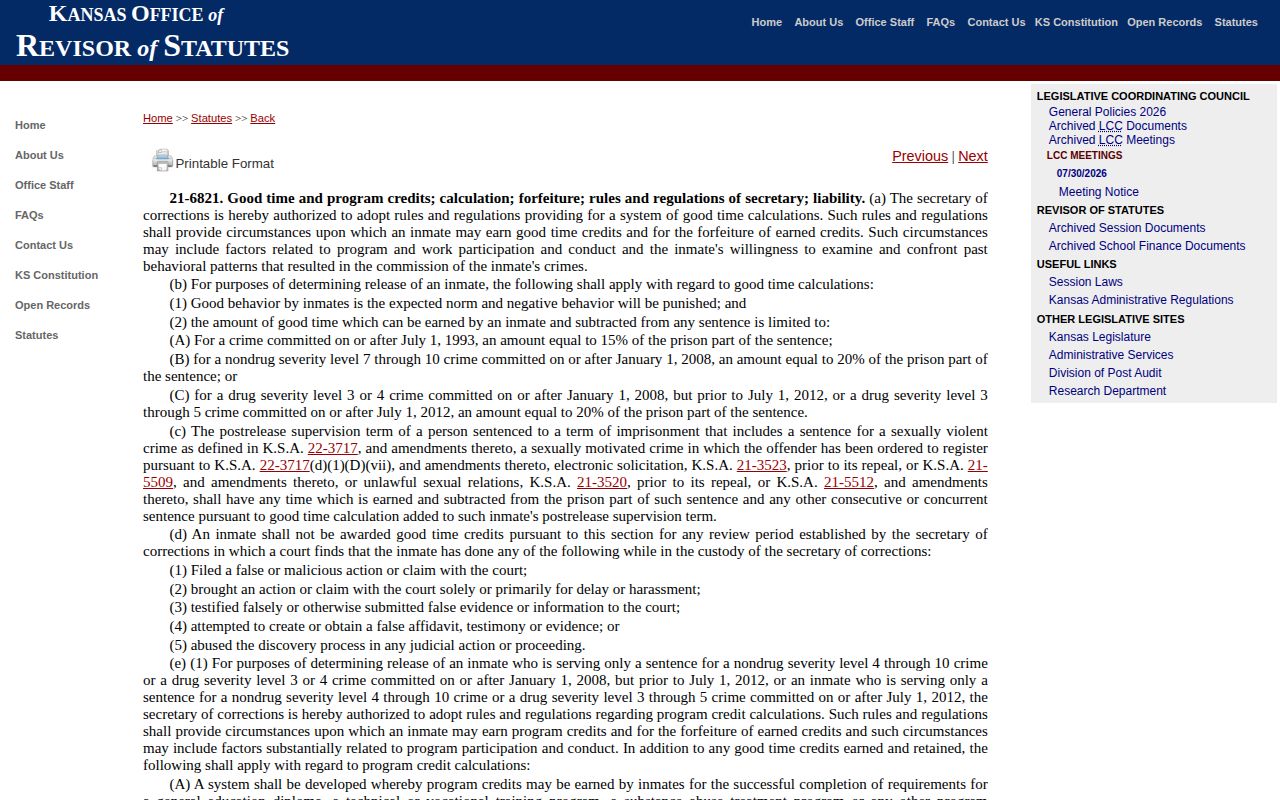
The statute must be applied to the actual offense date, severity level, sentence mix, and eligibility. It should never be turned into a flat percentage for every Kansas sentence. Sex-offender-treatment provisions, mixed sentences, and other statutory limits can also matter.
Rooks Parole Date Differences
K.S.A. 22-3717 creates another major divide. Many on-grid crimes committed on or after July 1, 1993 do not use discretionary parole. After completing the prison portion, the person begins mandatory postrelease supervision. Older indeterminate sentences and qualifying off-grid sentences may follow parole-eligibility and Kansas Prisoner Review Board procedures.
A parole eligibility date is not a release date. Eligibility only means the case can reach the parole process under the governing rules. The board may find the person suitable, continue the matter for more information, or pass the case for a stated interval. A monthly public-comment list is also not proof of a grant.
Special terms, including life without parole, defeat any general percentage formula. Offense date and sentence type must be known before labeling a date as parole eligibility, anticipated prison release, conditional release, postrelease supervision, or final discharge. The Rooks parole and probation record page explains how those supervision labels are verified.
Why Rooks Release Dates Change
A projected date can move in either direction as the official computation changes. Earned credit can bring the forecast forward. Lost credit, a disciplinary action, consecutive sentence, corrected journal entry, revocation, or another controlling term can move it later. The presence of a detainer may change the destination even when the KDOC prison portion ends.
- Good time was earned, withheld, restored, or forfeited.
- Eligible program credit was added after successful completion.
- The court corrected the sentence or jail-credit entry.
- A consecutive sentence or other controlling case changed the calculation.
- A supervision violation caused revocation or return to custody.
- Another agency lodged a detainer or became the receiving custodian.
If a displayed date has passed while KASPER still shows an institution, review the current location, movement record, supervision label, and controlling-sentence information. Contact KDOC Sentence Computation at 785-296-3317 with the KDOC number. Ask for the existing computation or release record instead of asking staff to create a new prediction.
Keep the old date and the new result as separate observations. Note the URL, query, date, local time, KDOC number, status, and institution or supervision office shown. A screenshot records what the system displayed at that moment, but it does not override the current agency record. If the explanation involves another sentence or detainer, identify the agency that owns that part of the custody chain.
Note: KASPER’s working-day update schedule can add delay around a recent event.
Rooks County Jail Release Dates
Do not apply KDOC’s 15% or 20% credit framework automatically to a local Rooks County Jail term. County jail sentences are not publicly calculated in KASPER unless the person enters a KDOC-linked system. The Rooks roster supplies a current-custody view, not a sentence calculator. Determine the court-imposed term and jail credit from the sentencing journal entry, then ask the jail for its existing calculated release information.
For a pretrial detainee, bond may authorize release once all required steps occur, but the posted bond amount does not show that bond was paid or processing finished. Call the Rooks County Jail at 785-425-6312. Ask whether the custody episode ended through bond, time served, court order, transfer to KDOC, transfer to another agency, or another recorded result.
A transfer is not community release. The local roster demonstrates that Rooks can hold people associated with Plainville Police Department, neighboring-county sheriffs, KDOC, and other agencies. When a name disappears, ask for the receiving custodian as well as the time Rooks custody ended. Those are two distinct facts. If KDOC received the person after felony sentencing, move to KASPER rather than applying a county-jail date.
The 23rd Judicial District record-search route can lead to the bond order, sentence, jail-credit entry, dismissal, probation order, or disposition. Exact administrative departure remains a sheriff fact. Request the booking/release record for a durable release timestamp.
Confirm Rooks Actual Release
After the anticipated date, reopen KASPER. A community-supervision location or parole, conditional release, or postrelease label can support physical departure from prison, subject to the system’s limits. It also shows why release is not the same as completion. The person may remain under KDOC authority.
- Compare the new KASPER status with the saved anticipated date and prior location.
- Read movement and supervision fields rather than relying on the date alone.
- Use the listed parole office when recent supervision data needs confirmation.
- Request the actual release record from the KDOC GovQA portal when documentary proof is needed.
- For the end of all KDOC supervision, request the certificate of discharge governed by K.S.A. 22-3722.
KASPER cannot currently display community-corrections probation events after April 21, 2021 during modernization, according to its disclaimer. For a Rooks probation case, use the court order and contact Court Services or Northwest Kansas Community Corrections as named there. A no-result response from one system does not answer a question assigned to another.
When final completion is the issue, request the certificate of discharge rather than treating a community address or expired forecast as enough. K.S.A. 22-3722 supplies the formal discharge distinction. A person may have left the institution, begun parole or postrelease supervision, and remained within KDOC legal custody for a later period. Label each stage with its own date.
The full Rooks County released inmate search provides the handoff among the jail, court, KASPER, VINE, federal, and immigration sources. Keep identifiers and timestamps separate so an anticipated date is never rewritten as an actual release.