
Rooks VINELink Coverage Boundary
Kansas Victim Information and Notification Everyday, or Kansas VINE, covers adults held in participating Kansas county jails. The Kansas Attorney General directs users to a current coverage map because local implementation can change. Rooks County participation should be verified there. The service can provide a present county-jail custody status and notifications tied to one selected detainee.
The most important limit is unusually clear: Kansas VINE does not include people housed in Kansas Department of Corrections state prisons. A Rooks County Jail detainee who transfers to KDOC leaves the county-jail system that VINE describes. Follow that person in KASPER and use KDOC Victim Services if its eligibility rules fit. Federal Bureau of Prisons and immigration custody also require their own systems.
| Custody path | Correct source | What it can establish |
|---|---|---|
| Participating county jail | Kansas VINE and the jail | Current status and a custody-change alert |
| KDOC prison or supervision | KASPER, KDOC records, KDOC Victim Services | State location, supervision, and corrections records |
| Federal prison | BOP Inmate Locator | Federal custody or reported release date |
| Rooks court case | District court record | Legal order, bond, disposition, or sentence |
Search Rooks VINELink Records
Use the official VINELink entry point for a specific-person search. Have the full first and last name ready. An offender ID is better when known because it reduces same-name errors. Telephone search can return an ID that should be saved for later checks. Search results must still be matched with care.
- Open VINELink and choose Kansas as the state.
- Enter the first and last name or offender ID for the selected person.
- Review all possible matches. Compare identifiers that the service lawfully displays.
- Open the matching record and read the present custody label and facility information.
- If Rooks does not appear as covered or the record is absent, call the Rooks County Jail and check the current Attorney General coverage map.
A no-result screen is not proof of release. The person may be entered under another spelling, held by a nonparticipating county, transferred to KDOC, moved to another custodian, or already released before registration. Use the booking number from the Rooks current roster when communicating with the jail. Never merge two records solely because names look alike.
The official VINELink capture shows the Kansas search and notification entry used for this process.
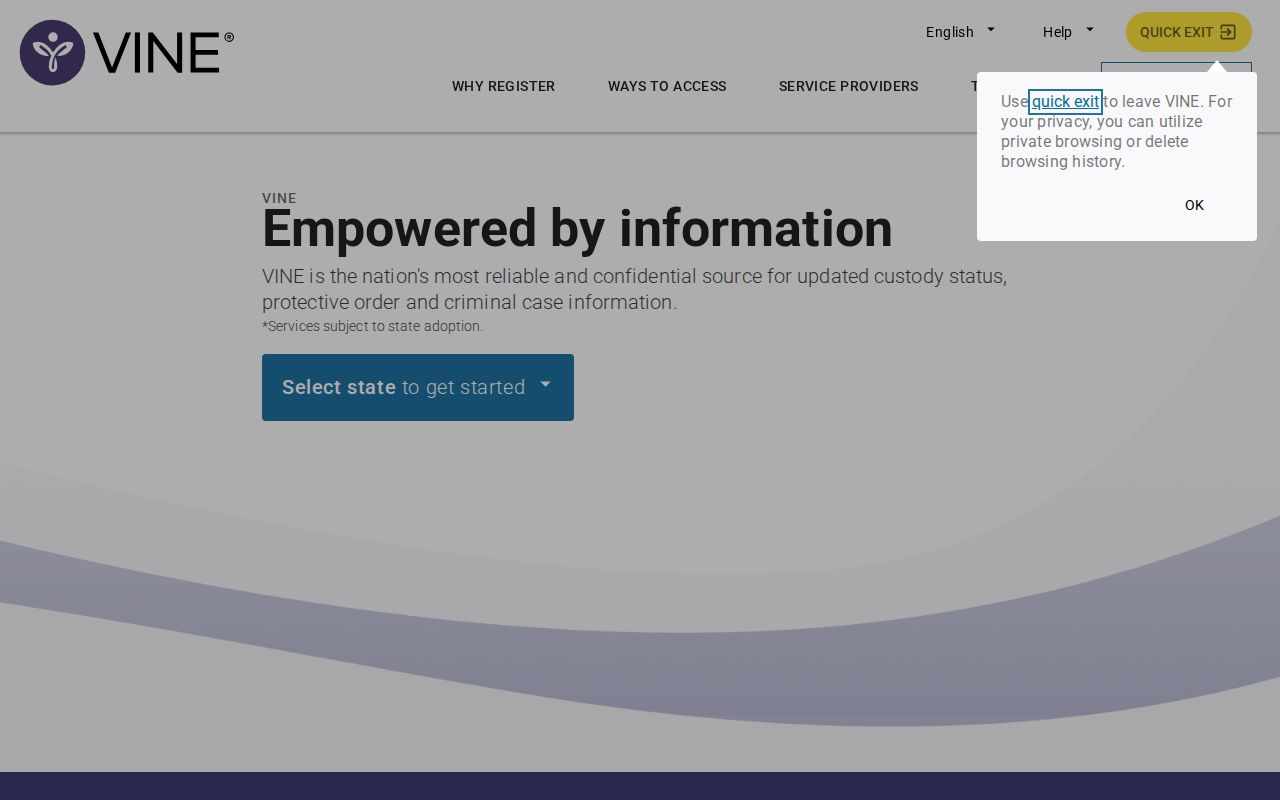
The image documents the portal interface, not a permanent result. Dynamic custody data should be checked again at the time a decision or contact is made.
Rooks VINELink Release Fields
VINELink is designed around status and notification. It is not the full Rooks booking and release record. A matching entry can identify the person or offender record, show present custody status, and associate the person with a participating facility. A released result or alert means the county-jail feed recorded a custody change. A transfer label must remain a transfer.
| Displayed item | How to read it |
|---|---|
| Name or offender ID | Identity key for the selected record; verify it against known facts |
| Custody status | The participating jail feed’s present status, subject to update lag |
| Facility or location | The custodian tied to that entry, not the court that controls the case |
| Release alert | A reported exit from that custody episode, not proof of case disposition |
| Transfer alert | Movement to another custodian, not release into the community |
For exact Rooks County release time, reason, authority, and transfer destination, call the jail at 785-425-6312 and request the existing booking/release record. The Rooks court docket can explain the bond order, dismissal, sentence, or other legal basis. Those sources answer questions that a VINE alert does not.
The live Rooks roster exposes fields that help with identity but not with release. It shows name, booking image, booking number, charges, bond, arresting agency, a compact “Date,” age, sex, and race. It does not show release time, release type, releasing authority, destination, a released toggle, or a date-range archive. Preserve the booking number before an entry disappears. That number gives the jail a much stronger way to locate the custody episode than a common name alone.
Register Rooks Release Notifications
Registration must attach to the matching in-custody record. It cannot create a retroactive alert for a release that already occurred. Kansas offers access through the VINELink web or app route and by telephone at 1-866-574-8463. TTY access is 1-866-847-1298. The current Kansas VINE brochure describes phone and electronic registration.
- Locate and verify the person while the participating jail still reports that person in custody.
- Choose registration and select the available phone, email, text, or app option.
- For phone alerts, enter and confirm the complete number, including area code.
- Create a memorable four-digit PIN and accept the registration.
- When a call arrives, listen to the notice, then enter the PIN followed by
#to acknowledge it and stop repeat calls.
Email does not use a PIN and sends one custody-change message. Text and app choices follow the options shown by the current platform. Keep the registration details private. Notifications can arrive at any hour. A missed call, spam filter, changed number, or communications delay can interrupt delivery, so VINE should supplement direct contact rather than replace it.
If telephone search supplies an offender ID, retain it for the next call. When more than one match appears, compare all lawful identity details before registering. An alert tied to the wrong record creates a false chronology that can be hard to correct. Registration should focus on the known detainee and the current custody episode, not on every person with a similar name.
Why Rooks VINELink Excludes KDOC
Kansas VINE’s county-jail boundary is a defining feature, not a small technical exception. If the Rooks County Jail says a detainee was transferred to KDOC, a later lack of county VINE information does not show community release. Search the KASPER gateway. KASPER can display state location, movement information, supervision type, anticipated release date, and the parole office maintaining supervision.
KDOC also operates a separate Victim Services notification route for a person in a KDOC facility or under KDOC supervision. Its phone number is 1-866-404-6732. This path is not a substitute for county VINE when the person remains in Rooks custody. Choose the service based on the current custodian.
- County release
- The person leaves the participating jail custody episode.
- Transfer
- The person leaves Rooks custody but remains confined by another agency.
- Postrelease supervision
- The person leaves state prison but remains under KDOC authority.
- Final discharge
- The applicable corrections supervision term formally ends.
Confirm Rooks VINELink Alerts
When VINE reports release, save the alert details and note the date and time received. Then contact the Rooks County Jail for the exact administrative event. Ask whether the person left on bond, time served, court order, transfer, or another documented outcome. If the answer is transfer, record the receiving agency and continue there.
A court case can remain open after bond release. This is not a conflict with VINE. The alert concerns custody; the Rooks court record concerns adjudication and can show the order that authorized release. For durable proof, request the sheriff’s booking/release record with full name, approximate booking date, and booking number.
Ask for release date and time, release reason or type, releasing authority, transfer destination when applicable, and bond information. These are requested fields, not a promise that every item must be disclosed. Juvenile, sealed, expunged, investigatory, safety-sensitive, or otherwise exempt material may be withheld. If a field is unavailable, distinguish “no record” from “record withheld” and from “another agency is the custodian.”
Data or communications issues can delay an alert. A live jail answer is stronger for exact departure than a saved notification. If online sources disagree, retain the URL, query, capture time, identifier, and status each displayed. That short chronology makes later verification much clearer.
Note: VINELink is a notification tool, not a released-inmate archive or a complete court history.
Rooks Release Check Alternatives
The correct fallback depends on the custody path. For a person last seen in Rooks County Jail, call the sheriff and ask a closed set of questions that includes release and transfer. For a KDOC case, use KASPER and request a corrections record if the current display is not enough. For probation, read the Rooks court order and contact Court Services or Northwest Kansas Community Corrections as named there.
Federal and immigration cases need separate checks. The BOP Inmate Locator can report a former federal prisoner’s release date, while an ICE locator result is aimed at current immigration custody and is not a historical release ledger. A KBI registry result applies only to a person with a statutory registration duty. It cannot stand in for a county or state release record. These boundaries keep a negative search from becoming a false claim that someone was released.
The Rooks County released inmate search connects all of those systems. The Rooks County inmate release date page explains why an anticipated KDOC date is a forecast. For a recent county-jail custody change, VINELink remains valuable when Rooks is currently participating and the registration was completed before release.
Keep each source within its role. The sheriff is strongest for exact county-jail departure, the court for the legal order, KDOC for state movement and supervision, and VINE for the selected county-jail alert. Write down the source URL, identifier, date, local time, and exact status label. Preserve both ends of any transfer. Recheck a time-sensitive result before sharing it with a family member or legal representative. A clean record of those handoffs prevents a release notice from being confused with a dismissal, discharge, or transfer.